
No confusing jargon. Just what you actually need to know.
Every year we observe, as soon as March hits, people start Googling ‘best AC under 40000 India’ or ‘best AC under 30000 India’ and end up more confused than when they started. We will find best AC for bedroom in India for 2026
There are a hundred options, every salesperson tells you something different, every website shows you different options and features and somehow you still don’t know which size is enough for your room or house
I’ve been there trust me. And honestly, it’s not as complicated as it seems — you just need a few things cleared up first.
So let me break it down for you so you will make the right decision.
First things first — what even is ‘Ton’?
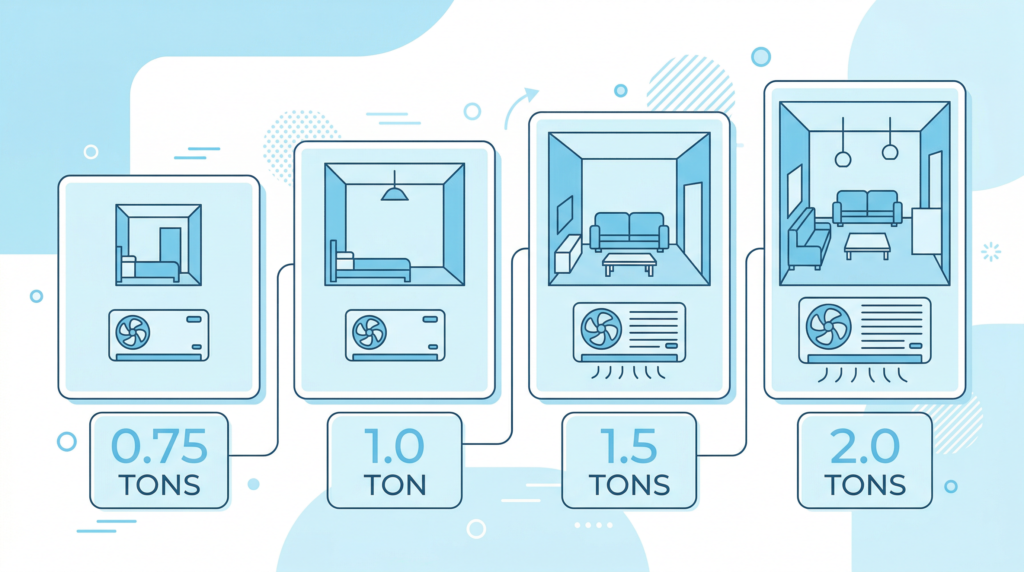
Ton has nothing to do with how heavy the AC is. It’s just a way to measure cooling power — specifically, how much heat the AC can pull out of your room per hour.
More tons = more cooling power.
But here’s the thing people miss: a bigger AC isn’t always better. If you put a 2-ton AC in a small bedroom, it’ll cool the room too fast, shut off, and then the room gets warm again and it kicks back on.
It keeps doing this on and off, and your electricity bill quietly goes through the roof. On top of that, it doesn’t run long enough to remove the humidity — so the room feels cold but weirdly sticky.
Too small is just as bad. The AC runs non-stop, never actually cools the room properly, and burns out faster. You want the right size — not the biggest one.
So how do you pick the right size?
The simplest way is to just measure your room. Here’s a rough guide that works well for most Indian homes:
| Room Size | Tonnage to Go With | Where It Usually Fits |
| Up to 100 sq ft | 0.75 Ton | Small bedroom or study |
| 100 – 150 sq ft | 1.0 Ton | Regular bedroom |
| 150 – 200 sq ft | 1.5 Ton | Master bedroom |
| 200 – 300 sq ft | 2.0 Ton | Living room or hall |
| 300+ sq ft | 2+ Ton | Large open spaces |
OTHER THINGS TO CONSIDER BEFORE BUYING:
- Does your room get direct afternoon sun? That heats it up way more than a shaded room.
- Are you on the top floor? Rooftop heat is real — your room absorbs it all day.
- High ceilings? More air to cool = more work for the AC.
- Do you have a big TV, a gaming setup, or lots of people in the room? All of that adds heat.
If any of those apply to you, bump up to the next size. Better to have a little extra capacity than to have your AC struggling every afternoon.
Star ratings — do they actually matter?
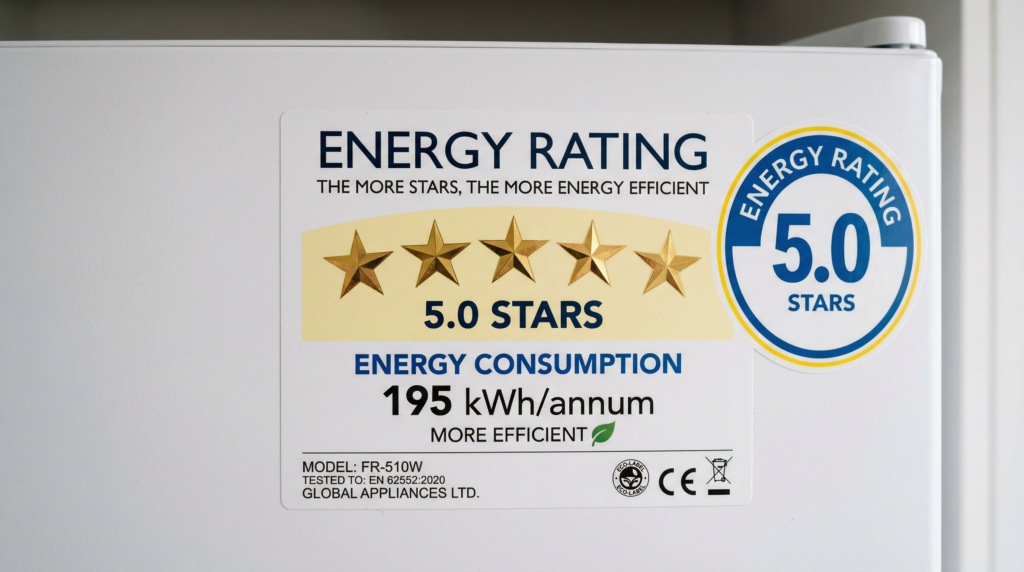
Yes, they genuinely do. The star rating (1 to 5) tells you how energy efficient the AC is. More stars = less electricity used for the same cooling.
In Indian conditions where you’re running the AC for 6+ hours a day for months at a stretch, this adds up fast.
A 5-star AC can easily save you ₹4,000–₹6,000 a year compared to a 3-star one.
The price difference between them is usually around ₹5,000–₹8,000, so you’re breaking even in about a year and saving after that.
My honest take: if you’re buying for a room you use daily, don’t cheap out on the star rating. It costs you more in the long run.
Inverter AC vs regular AC — is inverter AC worth the extra cost
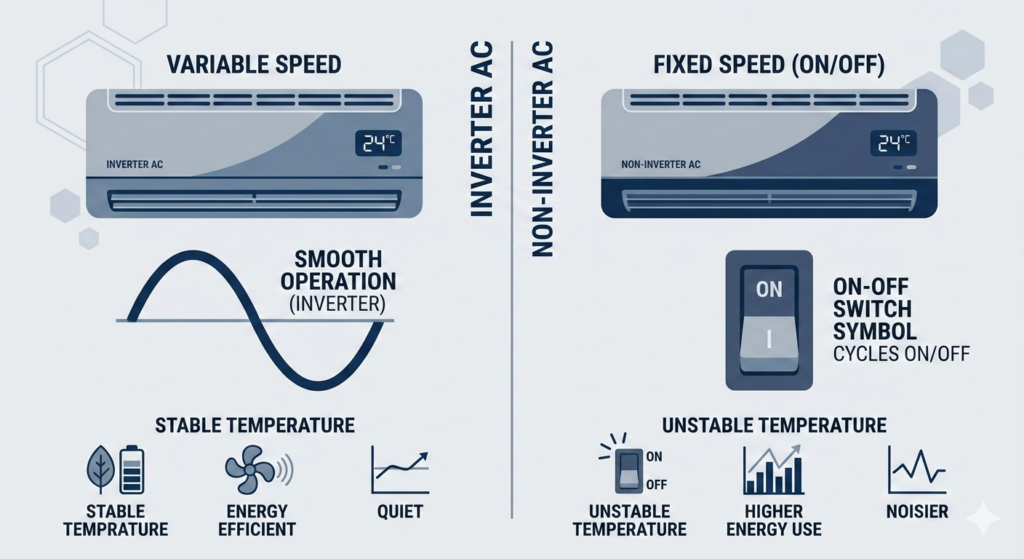
A regular (non-inverter) AC works like a light switch — fully on or fully off. When the room hits your target temperature, the compressor shuts off completely.
When it warms up again, it kicks back on at full blast. All that stopping and starting wastes electricity and puts stress on the motor.
An inverter AC is smarter. The compressor never fully shuts off — it just slows down to a low hum once the room is cool, then speeds back up gently as needed.
It’s more like a dimmer switch than an on/off switch.
It provides more consistent temperature, quieter operation, and noticeably lower electricity bills.
| Inverter AC | Regular AC | |
| Electricity bill | Lower (30–50% savings) | Higher |
| Upfront cost | A bit more expensive | Cheaper |
| Temperature consistency | Very stable | Fluctuates a little |
| Noise | Quieter | Louder when it kicks in |
| Worth it long term? | Yes | Only for very rare use |
Iinverter AC is most prefereble that regular AC
Split AC or Window AC?
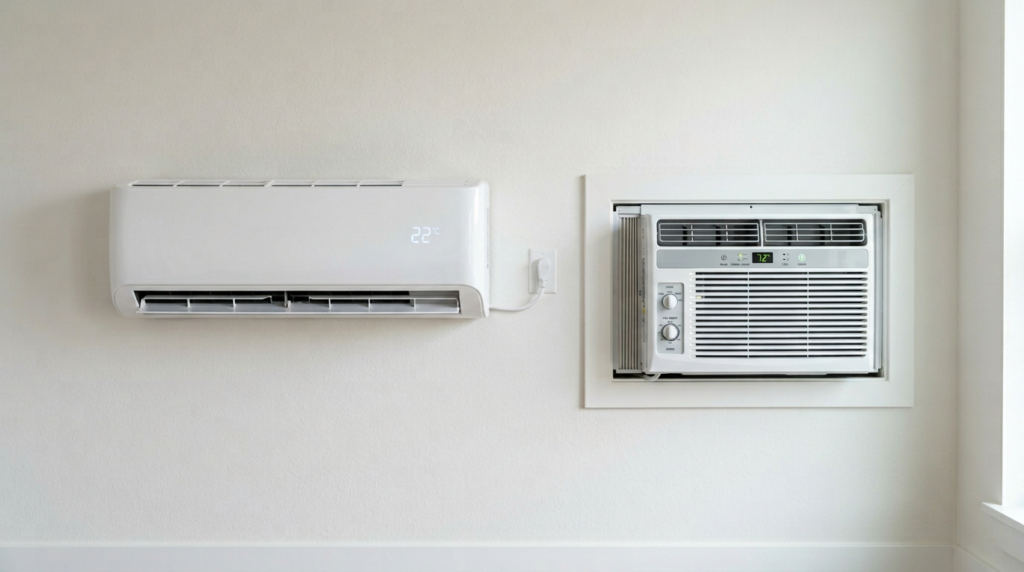
Window ACs are the older style where the entire unit sits in a window frame or wall slot.
They’re cheaper, easier to service, and honestly fine for a rental or a room you’re not in all the time.
The downside is noise — the compressor is right there in the room with you.
Split ACs have two parts: a sleek indoor unit on your wall and the noisy compressor outside.
Much quieter, looks better, and distributes air more evenly. Installation costs a little more and you’ll need a wall to drill into, but for a home you own, it’s the obvious choice.
Most people reading this are probably looking at split ACs, and that’s the right call.
Before buying an AC — Check this list
So you don’t get overwhelmed or upsold on something you don’t need:
- Measure your room (length × width). Know your square footage.
- Check if your room faces west or gets direct afternoon sun.
- Note if you’re on the top floor.
- Decide how many hours a day you’ll realistically use it.
- Budget for installation too — it’s usually ₹3,000–₹5,000 extra.
- Look for 4 or 5-star inverter models from brands like Daikin, LG, Voltas, or Blue Star.
- Check if there’s a service centre near you — it matters when something eventually needs fixing.
Conclusion
Buying an AC doesn’t have to be stressful. Measure your room, pick the right ton, go for an inverter model with a good star rating, and you’re 90% of the way there.
The rest is just brand preference and budget.
If you’re stuck between two options or have a weird room situation — drop it in the comments. Happy to help figure it out.
Stay cool out there. Literally.
Are you interested in Games Check out the new game Rainbow Six Siege
Leave a Reply