
A beginner-friendly look at specs, standards, and the gaps nobody warns you about
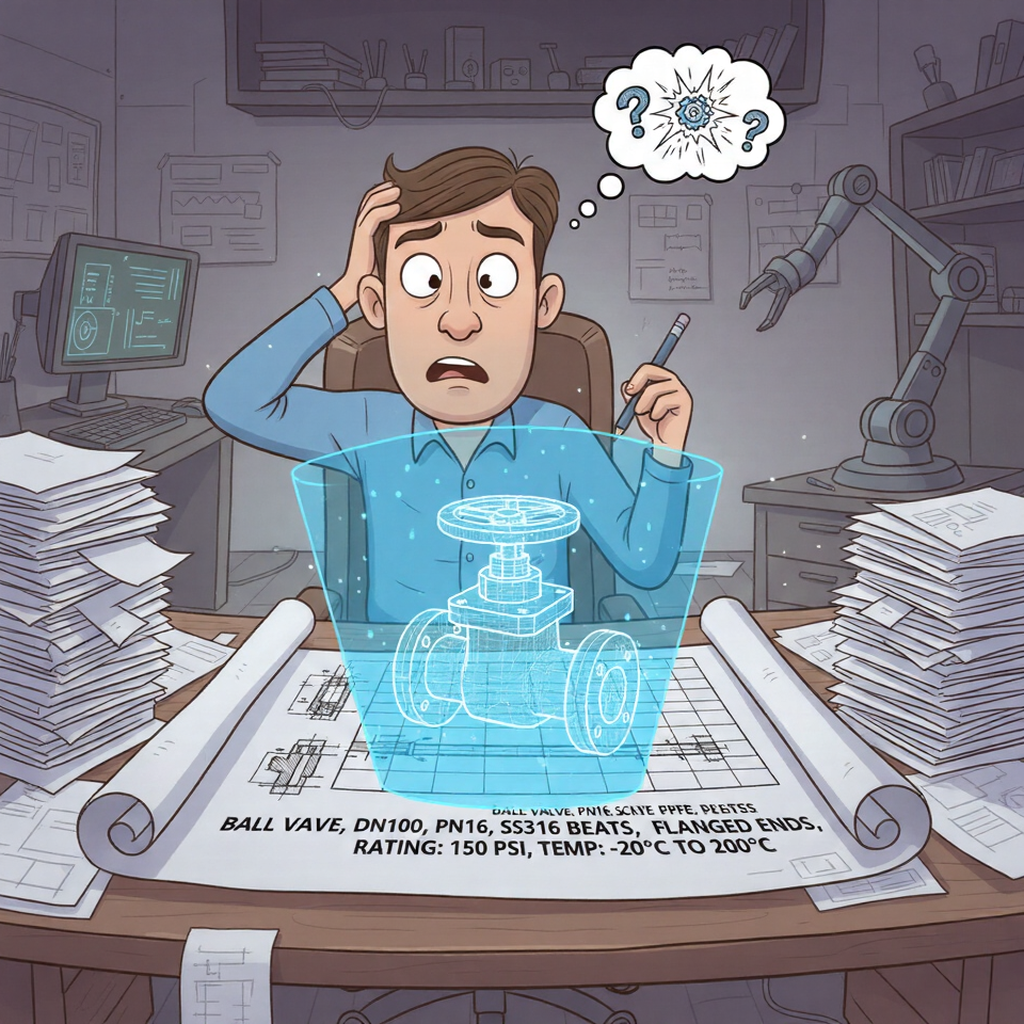
Introduction: The Comfort Lie
If you’re new to industrial engineering, valve drawings feel reassuring.
Clean lines.
Clear dimensions.
Pressure class, material, standard—all neatly written.
It feels like the problem is already solved.
And honestly? That feeling isn’t wrong. Drawings are essential. They are one of the most important communication tools in engineering. But here’s the quiet truth most beginners learn the hard way:
A drawing can look complete and still leave engineers confused.
Not because the drawing is bad.
But because drawings are designed to describe form, not behaviour.
What a Valve Drawing Actually Tells You
Let’s be fair before we get critical.
A typical valve drawing usually tells you:
- Nominal size (DN / NPS)
- Pressure class
- End connection type
- Face-to-face dimensions
- Basic material specification
- Applicable standard
This information is crucial. Without it, nothing fits, nothing aligns, and nothing installs.
But here’s the line every beginner should remember:
Drawings guarantee fit, not fitness.
They tell you where a valve fits — not how it will behave once fluid, pressure, temperature, and time get involved.
Standards: What They Guarantee — And What They Don’t
Most valve drawings reference standards like ASME, API, or ISO.
For beginners, standards feel like safety blankets. If it meets the standard, it must be good. Right?
Yes… but only up to a point.
Standards generally guarantee:
- Minimum design requirements
- Pressure and temperature limits
- Dimensional compatibility
- Baseline safety expectations
What they do not guarantee:
- Manufacturing quality
- Casting integrity
- Internal design philosophy
- Service life in your specific application
Two valves can comply with the same standard and still perform very differently in real service. That’s not a loophole—it’s how standards are meant to work.
They define the floor, not the ceiling.
Where Specification Confusion Begins
This is where most beginners start feeling uneasy, even if they can’t explain why.
“Same Rating” Does Not Mean Same Behaviour
A pressure class tells you what a valve can withstand, not how it handles flow, cycling, or wear.
Wall thickness, trim design, tolerances, and internal geometry all influence real performance—but they rarely appear on drawings.
Material Names Can Be Deceptive
Material callouts look precise on paper. Same grade, same code, same words.
But casting quality, heat treatment, and sourcing vary between manufacturers. Beginners often assume a material name automatically equals identical performance. Reality is messier.
The Most Dangerous Word: “Equivalent”
At some point, you’ll hear it:
“We don’t have that exact material, but we have an equivalent.”
Sometimes it’s harmless.
Sometimes it’s not.
The problem isn’t the substitution—it’s the uncertainty. Drawings don’t tell you how much margin the original design assumed.
The Material Availability Dilemma
This is where engineering leaves the classroom and enters the real world.
A drawing specifies Material X.
The supplier says Material X isn’t available.
They suggest Material Y.
On paper, it looks acceptable.
The standards check out.
The pressure class matches.
But now you’re stuck in the space between:
- Ideal design
- Practical availability
This hesitation beginners feel? That’s not weakness. That’s engineering judgment starting to form.
Engineering decisions often happen between what is ideal and what is available—and drawings don’t show you how to navigate that space.
The Missing Detail Nobody Talks About: Weight
Here’s something almost no beginner notices at first.
Most valve drawings don’t specify weight.
And weight matters. A lot.
Valve weight affects:
- Pipe stress and supports
- Installation and handling safety
- Actuator sizing
- Maintenance access
- Long-term reliability
A valve can meet every dimensional and pressure requirement and still cause problems simply because it’s heavier than expected.
Here’s the blunt truth:
Drawings respect standards. Gravity doesn’t care about standards.
What Beginners Should Actually Take Away
If you’re early in your career, don’t let this article scare you. Let it sharpen you.
Key takeaways:
- Drawings are starting points, not conclusions
- Specifications describe compliance, not behaviour
- Confusion early on is normal—and healthy
- Asking questions is part of engineering, not a failure
The moment you stop questioning drawings is the moment mistakes start sneaking in quietly.
Field Notes
- If something feels “too straightforward,” re-check assumptions
- Always ask what the drawing doesn’t say
- Document material substitutions clearly
- Engineering judgment grows faster than memorising rules
These habits matter more than perfect knowledge.
Valve drawings are not lies.
They’re just incomplete stories.
Engineering begins where documents end—where judgment, experience, and uncomfortable questions take over.
In the next post, we’ll step beyond the drawing and look at what happens after—where supplier codes, series numbers, and real-world constraints collide with clean specifications.
That’s where application engineering truly lives.
Leave a Reply